Artificial Intelligence (AI) has rapidly transformed from a niche academic field into the digital backbone of modern society. Behind the conversational interfaces, automated recommendations, and complex analytical systems lies a vast ecosystem of software, hardware, and global networking.
Understanding how AI functions requires looking past the screen to examine how it works fundamentally, where its servers are physically located, how they integrate with data centers, and how client applications communicate seamlessly with large language models (LLMs).
1. What Is AI and How Does It Work?
At its core, Artificial Intelligence refers to the simulation of human intelligence processes by computer systems. While traditional software follows rigid, human-authored rules (if-this-then-that logic), modern AI—specifically Machine Learning (ML) and Deep Learning (DL)—learns patterns directly from massive collections of information.
The Mechanism of Neural Networks
Modern generative AI relies heavily on Artificial Neural Networks, inspired loosely by the biological wiring of the human brain.
- Layers of Neurons: These systems consist of interconnected nodes (neurons) organized into input layers, hidden layers, and output layers.
- Weights and Biases: When data is fed into a network, numerical values called “weights” dictate how strongly one neuron influences another.
- Training and Optimization: During the training phase, the model makes predictions, measures its error against known answers, and uses mathematical techniques like backpropagation and gradient descent to adjust its weights. Through billions of iterations, the model minimizes its error until it can accurately recognize patterns or generate new content.
Large Language Models (LLMs) take this a step further by using Transformer architectures, which utilize a mechanism called attention. Attention allows the model to evaluate the contextual relationships between words in a sentence simultaneously, no matter how far apart they are, yielding fluent, human-like text generation and reasoning capabilities.
2. Where AI Lives: Servers and Modern Data Centers
An AI model cannot run efficiently on an average laptop or home computer; it requires immense computational power. This infrastructure is housed inside hyperscale AI data centers.
Physical Locations and Facility Design
Physically, AI data centers are massive, warehouse-like facilities strategically distributed around the globe. Providers like Google Cloud, Microsoft Azure, and Amazon Web Services (AWS) site these centers near robust electrical grids, renewable energy sources, and major fiber-optic communication corridors.
Unlike traditional data centers—which primarily handle routine web traffic and database queries using standard central processing units (CPUs)—AI data centers are purpose-built hardware powerhouses:
- AI Accelerators (GPUs and TPUs): Workloads are driven by specialized hardware like NVIDIA GPUs or Google’s custom Tensor Processing Units (TPUs). These processors execute thousands of mathematical operations concurrently (parallel processing), which is vital for handling multi-dimensional tensor computations.
- High-Bandwidth Memory (HBM) and Storage: To prevent processing bottlenecks, AI servers rely on ultra-fast memory technologies and high-speed NVMe solid-state drives that feed data directly to processors at gigabytes-per-second speeds.
- Extreme Power and Cooling Systems: A single modern AI server rack can consume immense amounts of electricity (often exceeding 40 to 120 kilowatts per rack). Because standard air conditioning cannot handle the concentrated thermal output, these facilities utilize advanced liquid cooling systems and specialized heat exchangers.
3. Connecting the Pieces: How Mobile Apps Link to LLM Servers
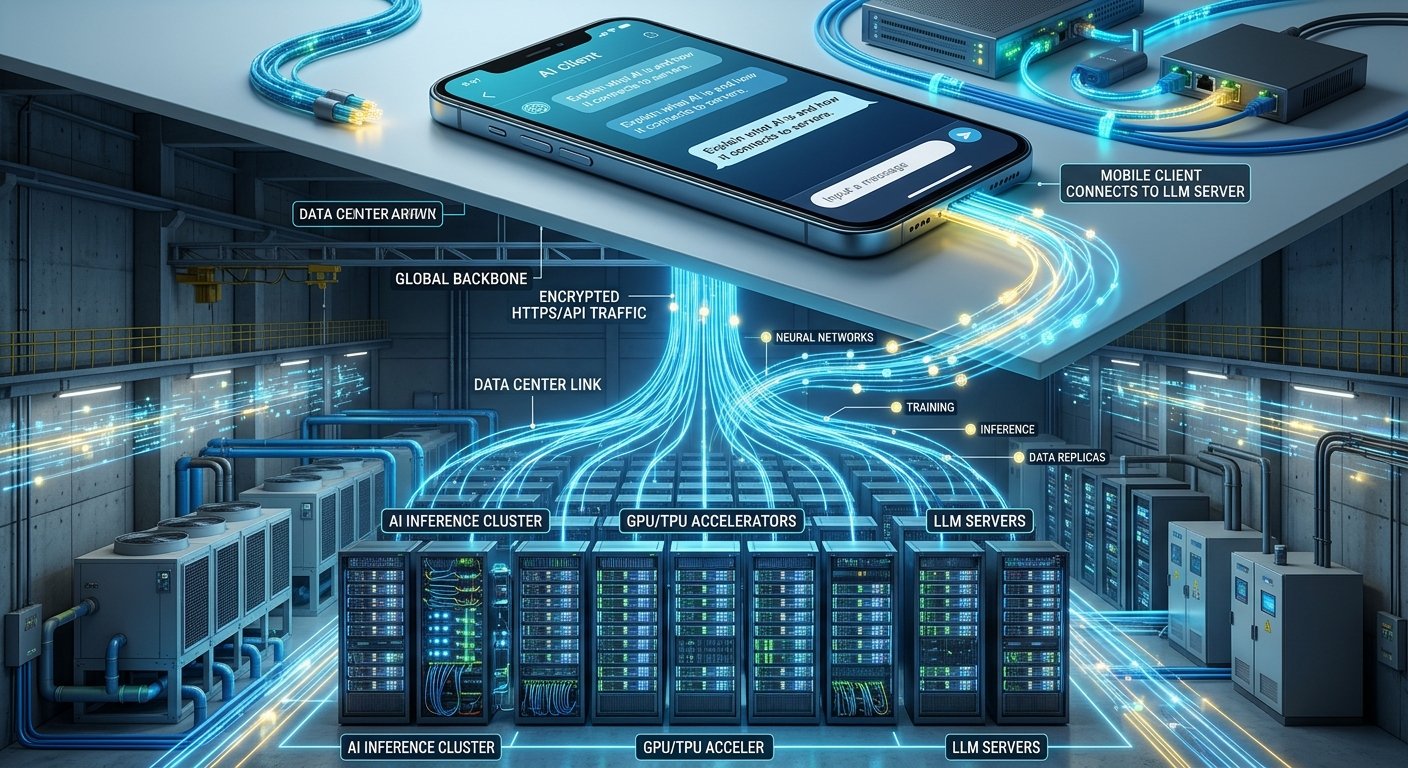
When a user opens an AI application on their phone—such as the Gemini app—and types a prompt, a sophisticated chain of networking events unfolds in milliseconds.
Step-by-Step Connection Lifecycle
- User Input and Serialization: When you submit a prompt on your mobile device, the app packages your text along with your account credentials, session history, and safety parameters into a structured digital payload (typically using JSON format over secure HTTP/2 or gRPC protocols).
- Wireless and Internet Transit: The phone transmits this data packet via your local 5G or Wi-Fi network to your internet service provider (ISP). From there, the packet races across terrestrial fiber-optic cables or undersea communication lines.
- Edge Routing and Load Balancing: The request hits the cloud provider’s Edge Network or Content Delivery Network (CDN) nearest to your geographic location. A load balancer intercepts the traffic and routes it to an available LLM inference cluster inside a regional data center, preventing any single server from becoming overwhelmed.
- Model Inference Execution: Inside the data center server cluster, the request is fed into the LLM inference engine. The model computes the response token by token using its massive parameter weights loaded across arrays of GPUs or TPUs.
- Streaming the Response Back: Because reading a long block of generated text all at once creates an unappealing delay, modern AI apps use streaming responses (via Server-Sent Events or WebSockets). As each word or token is calculated by the server, it is instantly shipped back down the networking pipeline to your phone, allowing text to appear on your screen in real time.