At its core, computer networking is the invisible infrastructure that allows billions of devices worldwide to communicate, share data, and access information. Whether you are loading a webpage, sending an instant message, or streaming a video, a complex suite of rules and mathematical structures works behind the scenes to deliver data accurately.
To understand how this digital ecosystem functions, we need to examine the foundational layers of networking: how data is transmitted using TCP/IP, why IPv4 addresses are structured the way they are, and how netmasks and network classes organize global traffic.
The Pillars of Communication: TCP and IP
When data travels across the internet, it is broken down into smaller pieces called packets. Two fundamental protocols—IP and TCP—work hand in hand to ensure these packets reach their proper destinations.
- IP (Internet Protocol): Operating primarily at the network layer, IP is responsible for addressing and routing packets so they can travel across multiple networks and reach the correct destination device. Every device connected to a network is assigned an IP address, which acts much like a physical mailing address. You can learn more about how this addressing functions through the Cloudflare Learning Center on TCP/IP.
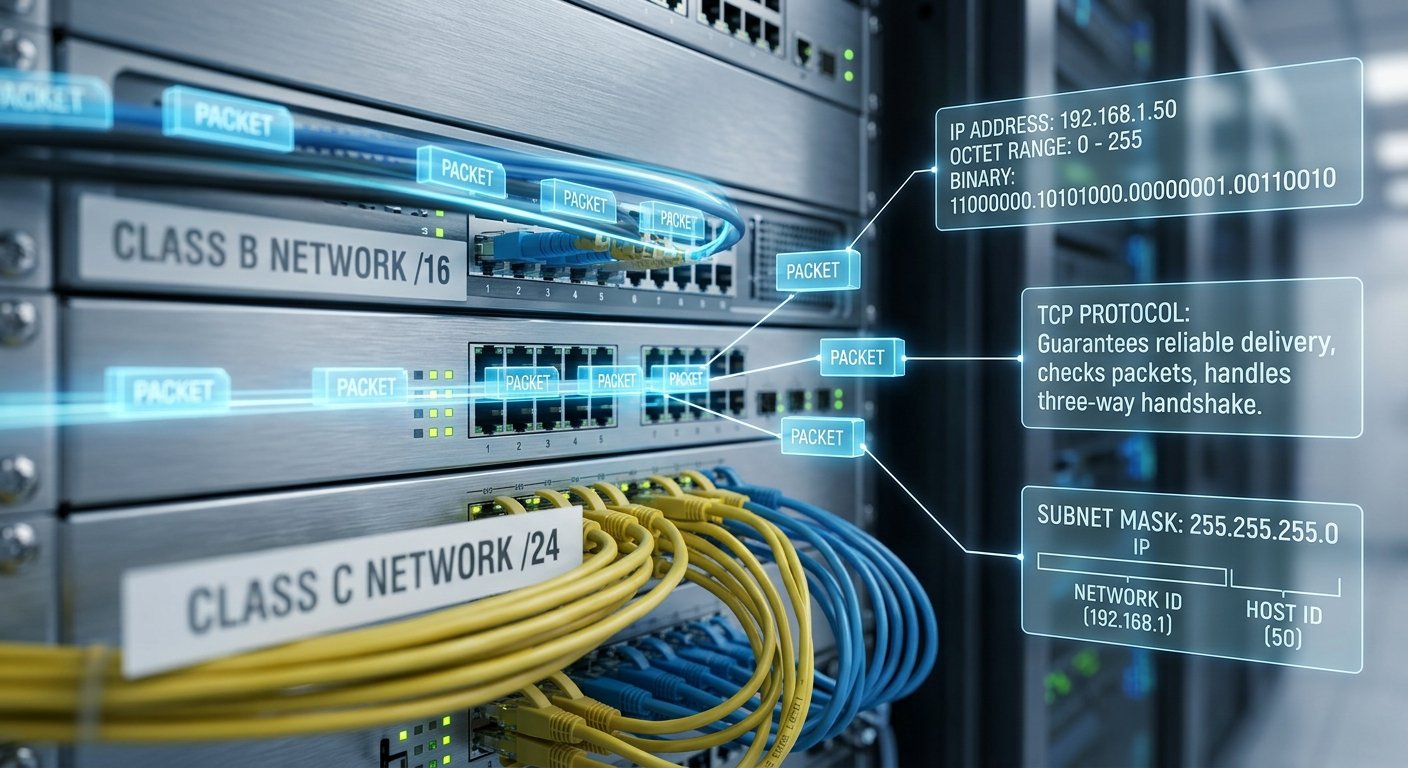
- TCP (Transmission Control Protocol): While IP handles the “where” (routing to the correct address), TCP handles the “how” (ensuring reliable delivery). TCP establishes a connection between the sender and receiver through a process called a “three-way handshake.” It checks for lost packets, retransmits them if necessary, and reassembles them in the correct order upon arrival. For a deeper breakdown of transport protocols, visit GeeksforGeeks on TCP.
The Math Behind the Octet: Why 255 is the Maximum
A standard IPv4 address is expressed as four numbers separated by periods (e.g., 192.168.1.1), a format known as dotted-decimal notation. Each of these four numbers is called an octet because it represents 8 bits of data.
To understand why 255 is the highest possible number in an IPv4 octet, we must look at binary code—the language of computers consisting of 1s and 0s:
- Each bit in an octet can hold one of two states (0 or 1).
- Because there are 8 bits in an octet, the total number of unique combinations is $2^8$, which equals 256.
- Because computers start counting at zero, these 256 values range from
0to255.
In binary, the number 0 is written as 00000000, and the number 255 is written as 11111111. If you want to explore the history and structure of IPv4 further, check out the Computer Hope IPv4 Overview.
Netmasking: Defining Network Boundaries
An IP address alone isn’t always enough for a router to know where a packet should go. It needs a companion called a subnet mask (or netmask).
A netmask is a 32-bit number that masks an IP address to divide it into two parts:
- The Network ID: Identifies the specific network the device belongs to.
- The Host ID: Identifies the specific device (host) on that network.
For example, consider a typical home network with the IP address 192.168.1.50 and a subnet mask of 255.255.255.0.
- The netmask tells the router that the first three octets (
192.168.1) represent the network, while the final octet (50) represents the individual device. - When a packet arrives, devices check the netmask to determine whether the destination is on the local network or needs to be routed out to the wider internet via a gateway.
To read a detailed tutorial on subnetting and bitwise operations, visit the GeeksforGeeks Subnet Mask Guide.
Classful Networking: Type A, B, and C Networks
In the early days of the internet, IPv4 addresses were categorized into classes (Classful Networking) based on the scale of the network. This system made it easy to allocate address blocks to organizations of varying sizes:
- Class A Networks: Designed for massive networks (such as large multi-national corporations or governments). They use the first octet for the network ID and the remaining three octets for hosts. Class A addresses range from
0.0.0.0to127.255.255.255, with a default subnet mask of255.0.0.0. - Class B Networks: Designed for medium-to-large networks (such as universities or large enterprises). They use the first two octets for the network ID and the last two for hosts. Class B addresses range from
128.0.0.0to191.255.255.255, with a default subnet mask of255.255.0.0. - Class C Networks: Designed for small local area networks (LANs), like home networks or small businesses. They use the first three octets for the network ID and only the final octet for hosts. Class C addresses range from
192.0.0.0to223.255.255.255, with a default subnet mask of255.255.255.0.
(Note: Classes D and E also exist for multicasting and experimental research, respectively). For official technical documentation on how these blocks are managed, consult the IANA IPv4 Address Space Registry.
Conclusion
Computer networking relies on a seamless blend of protocols, mathematics, and logical organization. Protocols like TCP and IP ensure data is structured and routed dependably, while binary math governs the limits of our addressing scheme through octets capping at 255. Layering on tools like netmasks and hierarchical network classes (A, B, and C) allows data to navigate local connections and global networks alike with remarkable precision.
Source List
- Cloudflare Learning Center. What is TCP/IP? Available at: Cloudflare TCP/IP Glossary
- GeeksforGeeks. TCP Connection Establishment and Termination. Available at: GeeksforGeeks TCP Guide
- Computer Hope. IPv4 Definition. Available at: Computer Hope IPv4 Overview
- GeeksforGeeks. Introduction of Subnet Mask. Available at: GeeksforGeeks Subnet Mask Guide
- Internet Assigned Numbers Authority (IANA). IPv4 Address Space Registry. Available at: IANA IPv4 Registry